Bulgaria
 English
 français
 Deutsch
 italiano
 русский
 español
 português
 العربية
 Nederlands
 한국의
한국의 Romania
 Melayu

In chlor-alkali chemical production, Ca2+ and Mg2+ are the two most common and most harmful cationic impurities. Excessive calcium and magnesium ions enter the electrolyzer along with the refined brine and migrate toward the cathode under the electric field. They penetrate the carboxylic acid layer of the ion-exchange membrane, undergo chemical reactions under electrolytic conditions, and the resulting hydroxide precipitates deposit in the ion channels of the carboxylic acid layer, causing micropore blockage of the ion-exchange membrane and scaling on the electrode surface. This leads to a series of problems including increased cell voltage, decreased electrolysis efficiency, and aging and damage of the ion-exchange membrane. In severe cases, it can cause unplanned shutdown of the plant, resulting in significant economic losses for the enterprise. Quantitative manifestations of damage: sustained increase in cell voltage (irreversible portion) with a rate of increase far exceeding normal aging; decreased current efficiency; and irrecoverable overall membrane performance.
1. Crude salt is the basic raw material for brine preparation. In industrial production, crude salt sources include sea salt, rock salt, and lake salt, with significant quality differences among different sources. If incoming crude salt batches change frequently and quality control is lax, large fluctuations and exceeding of calcium and magnesium impurity content may occur.
2. During brine refining, caustic soda, soda ash, and ferric chloride refining agents must be precisely dosed according to the crude brine flow rate and impurity content. Insufficient dosing results in incomplete calcium and magnesium precipitation reactions, causing primary brine calcium and magnesium to exceed standards; excessive dosing increases reagent consumption and interferes with subsequent operating conditions, deteriorating brine quality. Meanwhile, reaction pH, temperature, agitation intensity, and residence time are all key conditions for calcium and magnesium removal. Loss of control of these parameters will cause incomplete reactions, making filtration unable to retain impurities, ultimately resulting in non-compliant calcium and magnesium indicators in the refined brine.
3. Blockage of the clarifier tube settlers, failure of the preprocessor solid-liquid separation, and clogging or damage of the Kelai membrane pores can all result in incomplete retention of calcium and magnesium precipitates, allowing them to flow into downstream processes with the brine.
4. In the secondary refining process, if the chelating resin in the chelating resin tower is incompletely regenerated, the regeneration cycle is too long, the resin has reached its end of service life, or free chlorine is not thoroughly removed before entering the resin tower causing oxidative damage to the resin, its ion exchange capacity for removing calcium and magnesium ions will directly decrease.
5. Corrosion of carbon steel or low-grade stainless steel in the brine system under high-temperature brine and trace Cl2 environments leads to Fe3+ leakage into the brine.
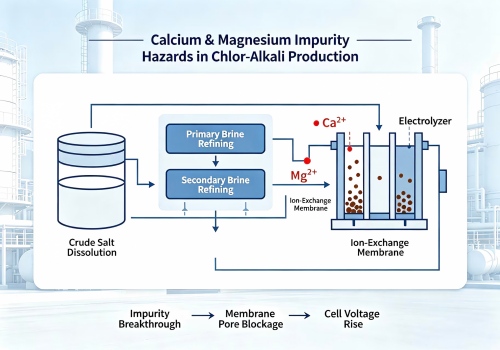
1. Emergency shutdown of the electrolyzer was performed, and the electrolyzer was washed twice with pure water at a water temperature not exceeding 40 degrees C.
2. Diagnose the contamination source: Sample from the feed brine sampling port and analyze Ca2+/Mg2+ (to confirm whether they exceed standards); review the secondary brine analysis records and resin tower regeneration records from the past 24-72 hours to confirm the breakthrough time point; open the resin tower inspection port to observe the resin color (normal: light yellow; oxidative damage: dark brown/black) and check for breakage; trace the chemical dosing records, reaction conditions, filtration pressure differential, etc.
3. Short-term measures after confirming the contamination source: Switch to the backup resin tower, replacing the contaminated resin tower with a freshly regenerated backup tower; immediately regenerate the contaminated resin tower; increase the primary refining agent dosage as an excess: increase the refining margin of the primary brine as a temporary measure; reduce current density: decrease the mass transfer driving force of Ca2+/Mg2+ into the membrane to slow further damage.
4. Medium-term measures after confirming the contamination source: Analyze and confirm whether it is a regeneration problem, resin end-of-life, insufficient primary refining, or a change in salt source; correct operating parameters, adjusting the regeneration cycle, dosing amount, or operating temperature according to the root cause; assess the degree of membrane damage, estimating the irreversible damage that has occurred through the magnitude of cell voltage increase and current efficiency decrease. If the cell voltage has increased by more than 50 mV and does not recover with changed operating conditions, early planning for membrane replacement should be considered.
5. Long-term measures after confirming the contamination source: (1) Membrane replacement: Membrane damage caused by Ca2+/Mg2+ is irreversible. If the voltage increase has significantly affected economic efficiency (additional power consumption > cost of premature membrane replacement), replacement should be made; (2) Systematic improvement: If Ca2+/Mg2+ breakthroughs occur repeatedly, improvements should be made from the source -- upgrade precision filtration equipment, add online monitoring, replace with higher exchange capacity resin, and switch to lower-impurity salt sources.
In the brine refining process of the chlor-alkali industry, the entire refining process ensures that the brine entering the electrolyzer meets extremely high purity standards through two stages of rigorous physical and chemical treatment. Brine refining is a systematic engineering process with extremely high requirements for detail. Only by combining strict process parameter control, standardized dosing and regeneration operations, and scientific equipment configuration can impurity-induced blockage and corrosion of the ion-exchange membrane be fundamentally prevented, thereby maintaining high current efficiency and extending the service life of core equipment.



 IPv6 ПОДДЪРЖА СЕ В МРЕЖАТА